
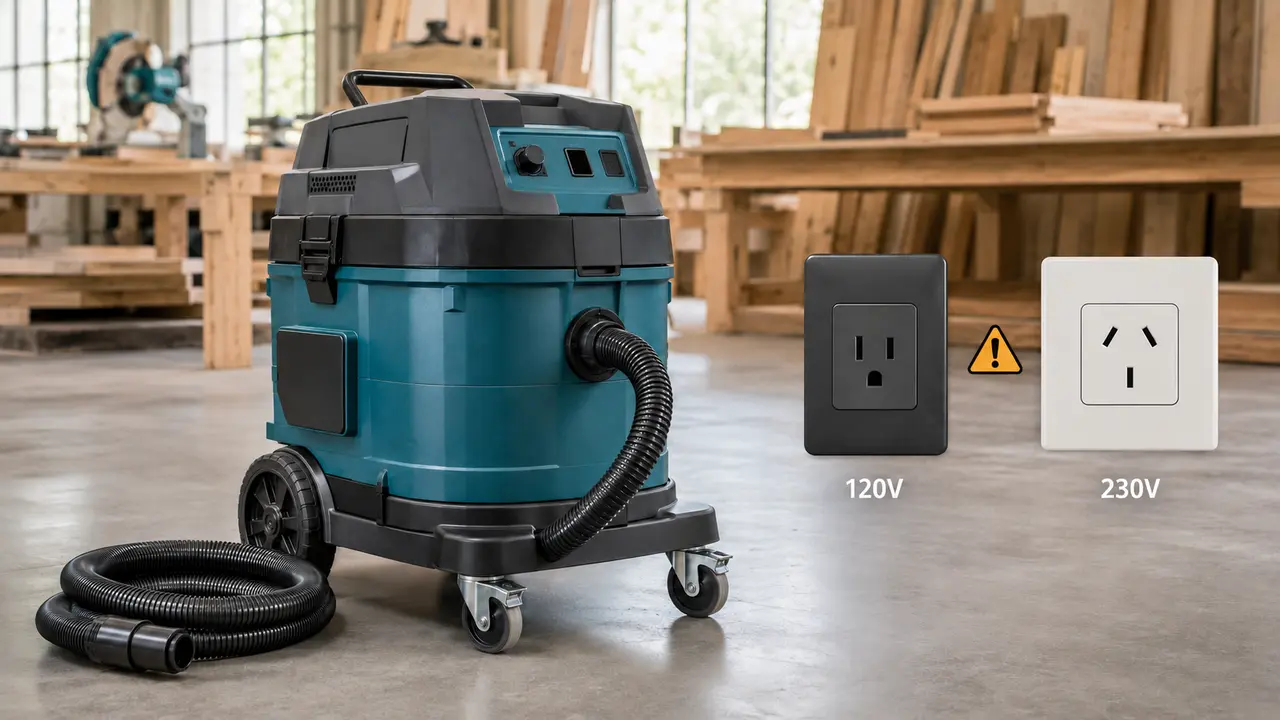
The Makita VC4710 is a large wet-and-dry dust extractor originally sold for the North American market. It combines a 47-litre tank, automatic filter cleaning, variable suction and power-tool activation.
However, there is one crucial issue for Australian buyers: the official VC4710 manual identifies it as a 120V, 60Hz US model. Australia’s electricity supply is nominally 230V, 50Hz, so the VC4710 is not designed to plug directly into a normal Australian power outlet.
Quick verdict for Australian buyers
The VC4710 remains a capable extractor when operated on its intended electrical supply, but it is generally not a sensible machine to import for use in Australia.
A simple travel plug adapter does not convert voltage or frequency. Connecting a 120V appliance directly to Australian mains power could damage the machine and create a serious electrical hazard.
Australian buyers will normally be better served by a locally supplied Makita extractor with the correct voltage, Australian warranty support and an appropriate dust classification.
Makita VC4710 specifications
The following figures come from the official Makita VC4710 operating manual.
| Specification | Makita VC4710 |
|---|---|
| Market/version | United States |
| Operating voltage | 120V |
| Frequency | 60Hz |
| Current rating | 12A |
| Maximum airflow | 3,200L/min or 135 CFM |
| Maximum vacuum | 230hPa or 92in H₂O |
| Tank volume | 47L or 12 US gallons |
| Weight | 12kg or 27lb |
| Dimensions | 380 × 450 × 750mm |
| Power cord | 7.5m |
| Sound level | 59 ± 2dB(A) |
| Sound pressure at 1m | 62 ± 2dB(A) |
| Protection rating | IPX4 |
| Filter cleaning | Automatic |
| HEPA filters | Optional, not standard |
Is the VC4710 compatible with Australian electricity?
No—not directly.
The VC4710 manual specifies a nominal 120V circuit and says that the supply voltage must correspond with the voltage shown on the machine’s rating plate. It also states that an adapter should not be used with the appliance.
Australian low-voltage networks supply approximately 230–240V at 50Hz, according to Victorian Government electricity guidance.
Therefore:
- Do not connect a US VC4710 directly to an Australian outlet.
- A plug-shape adapter is not a voltage converter.
- Do not assume that a transformer automatically makes the machine suitable, particularly because the frequency also differs.
- If you already own an imported VC4710, obtain advice from Makita and a licensed electrician before attempting to operate it.
Suction and dust extraction performance
The VC4710 produces up to 135 CFM of airflow and 92 inches of water lift. Airflow helps move dust through the hose, while water lift indicates the machine’s ability to maintain suction against resistance.
This combination made the VC4710 suitable for general workshop cleaning, wet pickup and source extraction from compatible power tools—provided it was operated according to the manual and on the correct electrical supply.
The machine also has variable suction control, allowing airflow to be reduced for tasks where maximum suction is unnecessary.
Automatic filter cleaning
The VC4710 uses an automatic filter-cleaning system designed to help maintain suction while the machine is operating.
Makita’s instructions specify that automatic filter cleaning applies when vacuuming without a filter bag. The manual also recommends performing a more complete cleaning when the filters become extremely dirty.
Automatic cleaning reduces filter loading, but it does not remove the need to inspect, maintain and eventually replace the filters.
Power-tool activation
The extractor includes an automatic operating mode. A compatible power tool can be connected to the extractor’s power outlet, causing the vacuum to start when the tool is switched on.
After the tool stops, the extractor continues operating briefly to draw remaining dust out of the hose.
For the US VC4710, the manual limits the connected tool to 5A, with a listed appliance-socket load of 600W. These figures relate specifically to the 120V US machine and should not be treated as Australian electrical specifications.
Does the Makita VC4710 include HEPA filters?
Not as standard according to the official manual.
The standard equipment list identifies two flat filter elements. Certified HEPA filter elements are listed separately as an optional accessory.
Makita states that the optional HEPA filters capture 99.97% of particles measuring 0.3 microns or larger. This performance claim applies only when the correct certified HEPA filters are installed.
A seller describing every VC4710 as a “HEPA vacuum” may therefore be referring to a machine fitted with the optional filters rather than the standard configuration.
Important hazardous-dust limitation
The VC4710 should not automatically be presented as suitable for silica, asbestos or other hazardous dust.
Its manual specifically warns that hazardous dust must not be collected with the machine. The optional HEPA filters do not by themselves establish compliance with Australian workplace requirements or turn the extractor into an Australian-certified dust-class machine.
For workplace dust extraction, select equipment that meets the dust class and control measures required by your risk assessment and applicable Australian safety requirements.
Standard parts and consumables
The official manual lists these VC4710 components:
| Item | Makita part number |
|---|---|
| Standard flat filter elements, pair | P-79843 |
| Filter bags, pack of five | P-78293 |
| Disposal bags, pack of five | P-70297 |
| Anti-static hose | P-79865 |
| Optional HEPA filter elements, pair | P-79859 |
Always confirm the machine model and part number before ordering. Availability in Australia may be limited because the VC4710 is a US-market model.
Australian-market alternatives
Australian buyers should compare locally supplied machines before importing a VC4710.
Makita VC2012LX1
The VC2012LX1 is a compact 20-litre wet-and-dry extractor approved for L-Class dust extraction. It offers 21kPa maximum sealed suction, power-tool activation and a manual Push & Clean filter system. See the current VC2012LX1 Australian listing.
Makita VC3012MX1
The VC3012MX1 is a 30-litre M-Class extractor with 25kPa maximum sealed suction, power-tool activation, filter cleaning and an airflow warning system. It is worth considering where an M-Class machine is required by the user’s dust-control assessment. See the VC3012MX1 Australian listing.
The appropriate model depends on the material being collected, the connected tool and the dust controls required for the job.
Should you buy a Makita VC4710 in Australia?
For most Australian buyers, no.
The VC4710 offers good capacity and useful automatic features, but its 120V/60Hz electrical specification is the deciding limitation. A locally supplied Makita extractor is likely to be safer, easier to service and more practical to own.
A used VC4710 may still make sense for someone operating in a 120V country. Before purchasing, check:
- The voltage and frequency shown on the rating plate
- Filter condition and type
- Availability of bags and replacement filters
- Hose and accessory condition
- Automatic filter-cleaning operation
- Power cord and tool-outlet condition
- Local parts and service availability
Frequently asked questions
Can the Makita VC4710 run from an Australian outlet?
Not directly. The VC4710 is rated for 120V/60Hz, whereas Australia supplies approximately 230V/50Hz.
Can I use a travel adapter?
No. A travel adapter only changes the plug shape; it does not convert the supply voltage or frequency.
Does the VC4710 come with HEPA filters?
The manual lists standard flat filters as basic equipment. Certified HEPA filters are optional.
What capacity is the VC4710?
Its tank volume is 47 litres, equivalent to approximately 12 US gallons.
Is the VC4710 suitable for asbestos or silica dust?
Do not assume so. The manual warns against collecting hazardous dust. Use an appropriately classified extractor and follow Australian workplace requirements.
What replaced the VC4710?
Makita USA identifies the VC4210L as its replacement model. Australian model numbers and certifications differ, so local buyers should compare current Australian-market extractors.
Final assessment
The Makita VC4710 is a capable older wet-and-dry extractor with strong airflow, automatic filter cleaning and a generous tank. Its main drawback for Australian shoppers is not performance—it is compatibility.
Because the VC4710 is a 120V/60Hz US machine, Australian buyers should generally choose a locally supplied alternative designed for 230V/50Hz operation.