
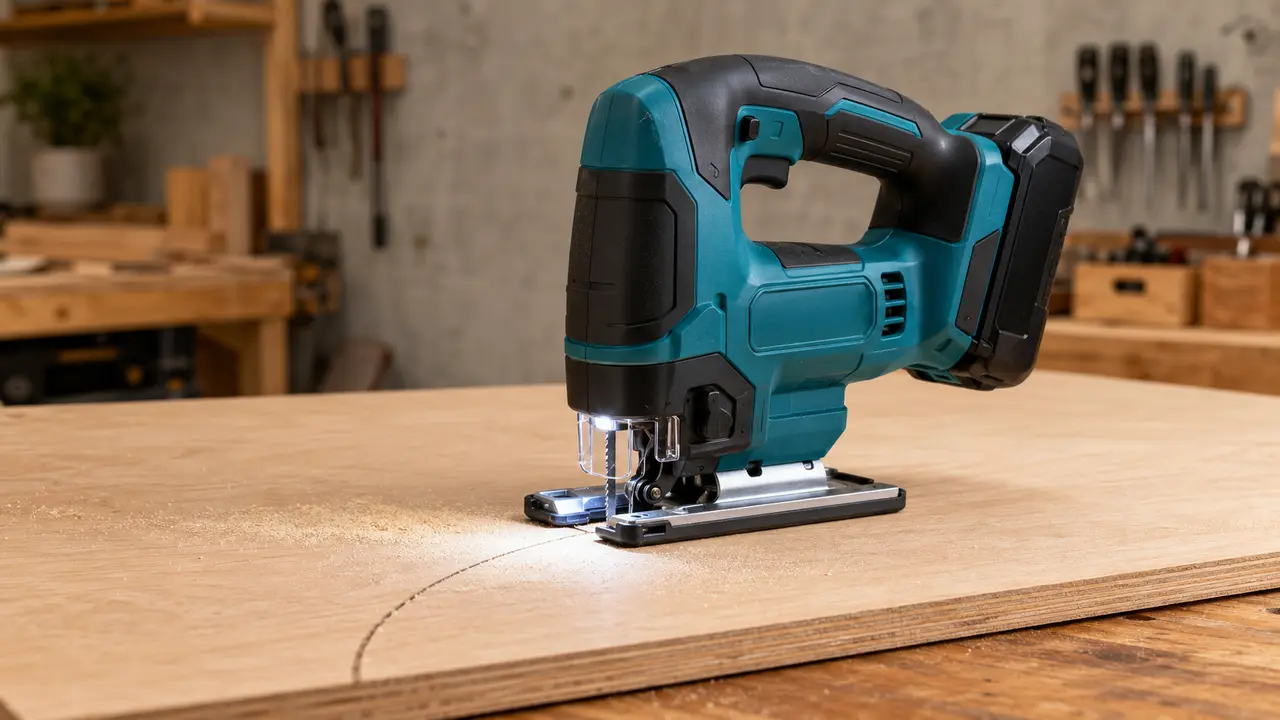
The Makita DJV182Z is an 18V LXT brushless D-handle jigsaw designed for curved cuts, internal cut-outs, bevels and general cutting in timber, sheet materials, plastics and metal.
Its specifications include a 26mm stroke, variable speed from 800 to 3,500 strokes per minute and a maximum cutting capacity of 135mm in wood. It also provides three orbital settings, a straight-cutting mode and tool-free blade changes.
The “Z” model is sold as a skin, so a battery and charger are not normally included.
This guide is based on official manufacturer information and the DJV182 instruction manual. It is not presented as a hands-on test.
Quick verdict
The DJV182Z is a strong option for tradespeople and serious DIY users who already own Makita 18V LXT batteries.
Its brushless motor, variable-speed dial and orbital-action control make it suitable for everything from cleaner plywood cuts to faster construction-timber cutting. Its main drawbacks are its premium positioning, skin-only package and soft no-load behaviour, which can initially feel unusual.
Makita DJV182Z specifications
| Specification | Makita DJV182Z |
|---|---|
| Battery platform | Makita 18V LXT |
| Motor | Brushless |
| No-load speed | 800–3,500 strokes per minute |
| Stroke length | 26mm |
| Maximum wood capacity | 135mm |
| Maximum mild-steel capacity | 10mm |
| Maximum aluminium capacity | 20mm |
| Cutting action | Straight plus three orbital settings |
| Bevel capacity | 0–45° left and right |
| Speed control | Six-position dial |
| Blade change | Tool-free |
| Dust blower | Built in |
| Dust extraction | Optional nozzle |
| Dimensions | 266 × 77 × 208mm |
| Skin weight | Approximately 2.0kg |
| Weight with battery | Approximately 2.4–2.7kg |
| Battery and charger | Not included with the Z model |
These figures are supported by the official Makita DJV182 product information and Makita DJV182 instruction manual.
What does DJV182Z mean?
The important part for buyers is the “Z” suffix. Makita uses this designation for a tool-only or skin package.
The DJV182Z therefore normally contains the jigsaw and applicable standard accessories but not an 18V battery or charger. Package contents can vary between retailers, so check the listing before purchasing.
For someone who already owns compatible Makita LXT batteries, buying the skin avoids paying for another charger. A new Makita user must include a suitable battery and Australian charger when calculating the total cost.
Brushless motor
The DJV182 uses a brushless motor rather than the brushed motor found in the older DJV180.
A brushless motor does not require carbon-brush replacements and allows electronic control of the motor. This generally provides more efficient use of battery power and reduces routine motor maintenance.
It does not make the jigsaw maintenance-free. The blade holder, base, vents and moving components still need to be kept clean and inspected for damage.
Cutting capacity
Makita specifies maximum cutting capacities of:
- 135mm in wood
- 10mm in mild steel
- 20mm in aluminium
These figures describe the maximum material thickness the machine is designed to cut under suitable conditions. They do not guarantee that every blade can cut to those depths.
Actual performance depends on the blade length, tooth design, material, orbital setting, battery condition and feed pressure.
For deep timber cutting, use a blade long enough to extend safely beyond the bottom of the workpiece throughout the complete stroke.
Variable-speed control
A numbered dial controls speed between 800 and 3,500 strokes per minute.
Makita provides these general starting ranges:
| Material | Suggested dial setting |
|---|---|
| Wood | 4–6 |
| Mild steel | 3–6 |
| Stainless steel | 3–4 |
| Aluminium | 3–6 |
| Plastic | 1–4 |
These are starting points rather than fixed rules. Blade type, material thickness and the required finish can change the appropriate setting.
Higher speeds generally cut faster but can increase blade wear, heat and surface damage. Excessive speed can melt some plastics or overheat metal-cutting blades.
Understanding the soft no-load function
The DJV182 has a soft no-load function that can surprise first-time users.
When the speed dial is set to position 3 or higher, the jigsaw may run slowly while the blade is not contacting the workpiece. Once cutting resistance is detected, the motor increases to the selected operating speed.
This behaviour is designed to reduce vibration when starting the tool. A slower idle speed does not necessarily mean that the battery is flat or that the motor is faulty.
Allow the blade to reach its operating behaviour before forcing the tool into the material.
Straight and orbital cutting modes
The DJV182Z provides straight cutting plus three levels of orbital action.
During straight cutting, the blade moves mainly up and down. Orbital action also moves the blade slightly forward during the cutting stroke, increasing cutting speed.
Straight-cutting mode
Use the straight setting when accuracy and finish are more important than speed. It is generally appropriate for:
- Cleaner cuts in timber and plywood
- Thin or delicate materials
- Plastics
- Mild and stainless steel
- Tight curves
Small orbital action
A small orbit can improve cutting speed while retaining reasonable control. It can be useful for hardwood, aluminium and some steel-cutting applications when paired with the correct blade.
Medium or large orbital action
The larger settings are intended primarily for faster cutting in timber and plywood.
Greater orbital movement normally produces a faster but rougher cut. It is less suitable for fine surfaces, laminates and tight curves where edge quality matters.
Always test the selected speed and orbital setting on scrap material when the finished surface is important.
Tool-free blade changes
The blade holder allows blades to be installed and removed without a separate blade-changing tool.
Before changing a blade:
- Remove the battery.
- Allow the blade to cool.
- Clear chips from the blade holder.
- Insert the blade with its teeth facing forward until it locks.
- Pull it lightly to confirm that it is secure.
A blade that is not fully locked can detach during operation. Follow the procedure in the manual rather than relying only on the appearance of the blade holder.
Choosing the correct blade
The quality of a jigsaw cut depends heavily on the blade. The DJV182 uses bayonet or T-shank-style jigsaw blades.
Choose a blade according to the material and finish required:
- Fine-tooth timber blades for cleaner plywood and cabinetry cuts
- Coarse timber blades for faster construction cuts
- Down-cut blades where reducing damage to the top surface is important
- Bi-metal or high-speed-steel blades for suitable metal
- Special blades for laminate, plastic or stainless steel
- Narrow scrolling blades for tight curves
The maximum capacity of the jigsaw should not be confused with the cutting capacity of an individual blade.
Bevel cutting
The aluminium base can be tilted from 0 to 45 degrees in either direction.
Changing the bevel angle requires the supplied hex wrench. The battery should be removed before loosening or adjusting the base.
The anti-splintering insert cannot be used while making bevel cuts, according to the manual. Make a test cut before working on the finished material because bevel cutting reduces the effective cutting depth and can make blade deflection more noticeable.
LED light and dust blower
An integrated LED illuminates the cutting area when the tool is placed in standby mode.
The jigsaw also has a built-in blower that helps move loose sawdust away from the marked cutting line. This can improve visibility, but a blower is not a replacement for dust extraction.
For cleaner operation, Makita offers an optional dust nozzle that can be installed on either side of the base and connected to a compatible vacuum.
The original article incorrectly implied that the complete dust-extraction connection was necessarily included. Confirm the package contents because the nozzle may be an optional accessory.
Anti-splintering insert and cover plate
An anti-splintering insert can help reduce breakout during straight cuts in suitable timber and sheet materials.
A cover plate can also protect delicate finished surfaces from scratches caused by the metal base. These accessories are useful when cutting cabinetry panels, laminate or prefinished boards.
Availability in the standard package can differ by country and retailer.
D-handle design
The DJV182 uses a conventional top or D-handle with a trigger switch. This layout is familiar to many users and provides easy access to the trigger while guiding the saw.
A separate lock switch places the tool into standby or lock-off mode. The lock-on button performs a different function: it keeps the trigger engaged during continuous cutting.
The lock-on button should therefore not be described as the feature that prevents accidental starting.
Users who prefer to grip closer to the cutting surface may instead consider the barrel-handle DJV181, which has similar core cutting specifications but a different body design.
Australian battery compatibility
The jigsaw itself runs from an 18V Makita LXT battery and does not connect directly to mains electricity.
Compatible battery capacity affects runtime and balance rather than the tool’s maximum voltage. A larger battery normally provides longer operation but adds weight.
If buying an imported kit, pay particular attention to the charger. Only use a genuine compatible charger marked for the available Australian electricity supply. Do not connect an overseas 110V charger directly to an Australian outlet.
Advantages
- Brushless 18V LXT motor
- 135mm maximum wood capacity
- Six-position variable-speed dial
- Straight plus three orbital settings
- Tool-free blade changes
- Bevel cutting in both directions
- LED work light
- Built-in dust blower
- Optional vacuum connection
- Electronic brake
- Lock-off and continuous-operation controls
Limitations
- Battery and charger are not included
- More expensive than basic DIY jigsaws
- Soft no-load behaviour can initially seem unusual
- Dust nozzle may need to be purchased separately
- Larger batteries increase operating weight
- A jigsaw cannot match a circular or track saw for long, perfectly straight cuts
- Cut quality depends heavily on using the correct blade
Who should consider the DJV182Z?
The DJV182Z is best suited to someone who:
- Already owns Makita 18V LXT batteries
- Regularly cuts curves, openings or irregular shapes
- Wants a brushless professional-grade jigsaw
- Needs variable speed and orbital control
- Prefers a traditional D-handle
- Works with timber, sheet products, plastics and occasional metal
A less expensive jigsaw may be sufficient for occasional household projects. For long straight cuts in sheet material, a circular saw or guide-rail saw will normally produce a straighter result.
Important safety points
Always read the manual supplied with the tool. Basic precautions include:
- Remove the battery before changing blades or adjusting the base.
- Clamp the workpiece securely.
- Keep the base flat against the workpiece during cutting.
- Check for hidden wiring before cutting into walls or enclosed structures.
- Wear appropriate eye, hearing and respiratory protection.
- Use a blade designed for the material.
- Keep hands clear of the blade and the area beneath the workpiece.
- Allow the blade to stop completely before lifting the saw.
- Do not touch the blade immediately after cutting because it may be extremely hot.
Frequently asked questions
Is the Makita DJV182Z brushless?
Yes. It uses a brushless 18V LXT motor.
Does the DJV182Z include a battery?
No. The Z version is normally supplied as a tool-only skin.
What is its maximum wood-cutting capacity?
Makita specifies a maximum capacity of 135mm in wood when cutting at 90 degrees with a suitable blade.
What blades does it use?
It accepts bayonet or T-shank-style jigsaw blades. Select the blade according to the material, thickness and required finish.
Why does it run slowly before touching the material?
This is normally the soft no-load function. At dial settings of 3 or above, the tool reduces idle speed and increases speed when it encounters cutting load.
Does it have orbital action?
Yes. It provides three orbital settings plus a straight-cutting mode.
Can it make bevel cuts?
Yes. The base can be adjusted up to 45 degrees to the left or right.
Does it connect to a vacuum?
Yes, but the appropriate dust nozzle may be an optional accessory.
Final assessment
The Makita DJV182Z combines a useful 135mm timber capacity with a brushless motor, adjustable orbital action and a broad speed range.
It is particularly attractive to existing Makita LXT users because they can purchase the skin and use batteries they already own. Its controls provide considerably more flexibility than a basic fixed-speed jigsaw.
It is not automatically the best option for every DIY user. Buyers should consider the total cost of batteries, the type of work they perform and whether they prefer a D-handle or barrel grip. For regular curved cutting and detailed construction work, however, the DJV182Z remains a capable and versatile 18V jigsaw.