
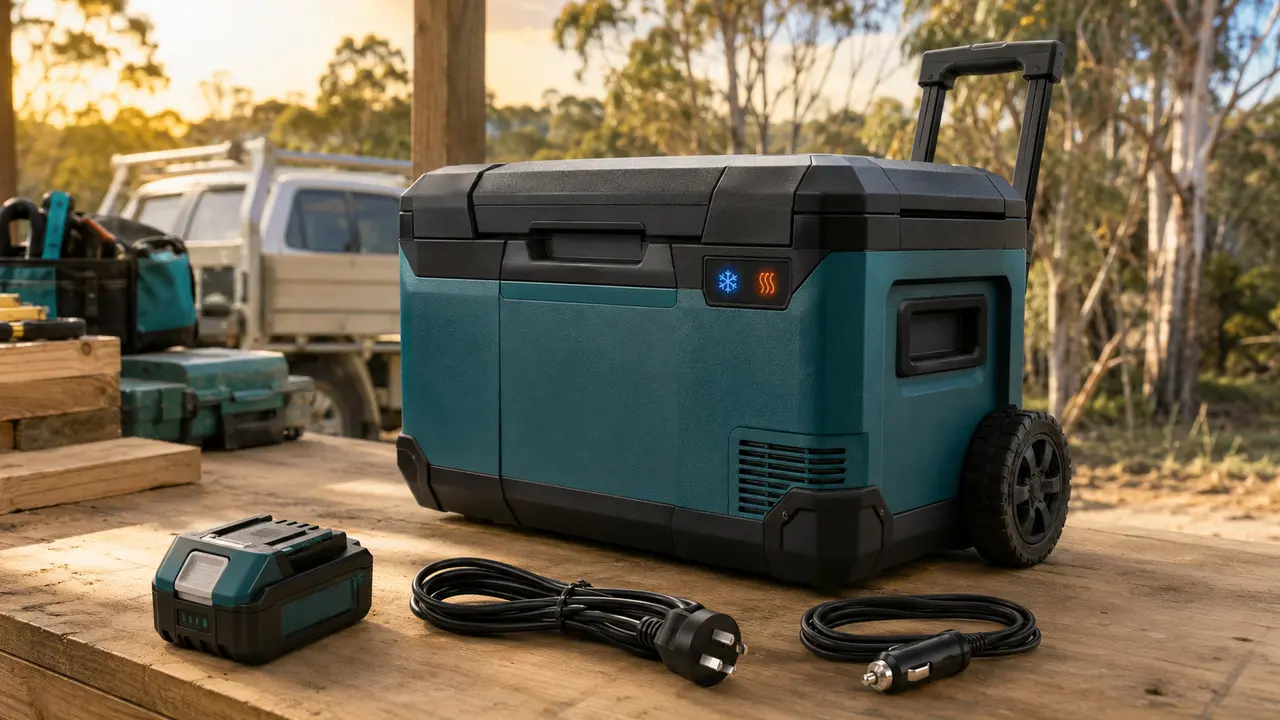
The Makita DCW180Z is a 20-litre portable compressor cooler and warmer designed for jobsites, camping, road trips and outdoor activities.
Unlike a conventional insulated icebox, it actively cools or warms its contents. It can operate from Makita 18V LXT batteries, a compatible AC adapter or a 12V/24V vehicle socket.
Its ability to cool down to −18°C is impressive, but there are important limitations to understand before buying. The DCW180Z is heavy, battery runtime varies considerably with the selected temperature, and specifications can differ between regional versions.
This guide is based on official manufacturer documentation and specifications. OzPowerTools has not conducted a hands-on test of this product.
Quick verdict
The Makita DCW180Z is most appealing to tradespeople and campers who already own Makita 18V LXT batteries.
Its genuine compressor system, multiple power options and 20-litre capacity make it considerably more capable than a passive cooler. It can keep drinks cold, maintain chilled food or reach sub-zero temperatures without relying on ice.
However, it weighs approximately 13kg before batteries or contents are added. Buyers who only need an occasional drinks cooler may find a standard icebox lighter, simpler and substantially less expensive.
Makita DCW180Z specifications
The specifications below apply to the commonly documented DCW180 model. Buyers should confirm the rating plate, power adapter and instructions supplied with the exact machine being considered.
| Specification | Makita DCW180Z |
|---|---|
| Internal capacity | 20 litres |
| Cooling system | Compressor |
| Cooling settings | −18°C, −10°C, 0°C, 5°C and 10°C |
| Warming settings | 55°C and 60°C |
| Battery compatibility | Makita 18V LXT |
| Battery positions | Up to two |
| Other power sources | Compatible AC adapter and 12V/24V vehicle adapter |
| External dimensions | 623 × 341 × 371.5mm |
| Internal dimensions | 323 × 240 × 261mm |
| Weight without battery | Approximately 13kg |
| Weight with two 6.0Ah batteries | Approximately 14.3kg |
| USB output | USB-A, 5V/2.4A |
| Water-resistance rating | IPX4 when operating from battery power |
| Stated bottle capacity | Twenty 500ml bottles or four 2-litre bottles |
These figures come from the official Makita DCW180 instruction manual and Makita’s DCW180 product information.
Cooling and warming performance
The DCW180 uses a compressor rather than a simple thermoelectric cooling plate. This allows it to provide five cooling presets:
- −18°C
- −10°C
- 0°C
- 5°C
- 10°C
Two warming presets are available:
- 55°C
- 60°C
The selected figure is a control temperature, not a promise that warm contents will immediately reach that temperature. Performance depends on the ambient temperature, ventilation, how frequently the lid is opened and the starting temperature of the contents.
Pre-chilling drinks and food before loading the cooler can significantly reduce the time and energy needed to reach the selected temperature.
Battery, AC and vehicle power
The DCW180Z offers three practical power options.
Makita 18V LXT batteries
The cooler accepts up to two compatible Makita 18V LXT battery packs. However, the official manual states that the appliance uses one battery at a time.
Installing a second battery extends the available operating time; it does not turn the cooler into a 36V appliance.
The DCW180Z is normally sold as a tool-only model, so batteries and a Makita battery charger may not be included. Package contents vary between sellers and countries, so check the listing carefully.
AC power
The unit can operate from a compatible AC adapter. The adapter powers the cooler but should not be confused with a Makita LXT battery charger. LXT batteries must be recharged using an appropriate Makita charger.
Australian buyers should confirm that the supplied AC adapter is designed for Australian mains electricity and has the correct plug.
Vehicle power
A compatible 12V/24V vehicle adapter allows the cooler to operate from a vehicle accessory socket.
Makita’s manual advises users not to operate the appliance while driving and warns that prolonged use can drain the vehicle battery. Secure the cooler properly in the luggage area or another stable position before travelling.
How long does the Makita DCW180Z run?
Battery runtime varies substantially according to the ambient temperature, battery capacity and selected operating mode.
Makita provides these approximate examples:
| Battery and conditions | Selected temperature | Approximate runtime |
|---|---|---|
| One BL1860B 6.0Ah battery at 30°C ambient | −18°C | 2.5 hours |
| One BL1860B 6.0Ah battery at 30°C ambient | 5°C | 8.5 hours |
| One BL1860B 6.0Ah battery at 0°C ambient | 60°C | 2 hours |
| Two 6.0Ah batteries | 5°C | Up to 17 hours |
| Two 6.0Ah batteries | 60°C | Up to 4 hours |
The single-battery results come from the official DCW180 manual. The two-battery figures are published in Makita’s European DCW180 product information.
These are controlled manufacturer estimates, not guaranteed runtimes. Starting with warm drinks, opening the lid regularly or operating in direct summer sun will usually reduce runtime.
Capacity and portability
The 20-litre compartment can accommodate approximately twenty 500ml bottles or four upright 2-litre bottles.
That is a useful capacity for drinks and lunches, but the DCW180 has only one temperature compartment. It cannot simultaneously freeze food in one section and keep other contents warm in another.
The machine weighs approximately 13kg without batteries. Once two batteries, food and drinks are added, lifting it may require some care.
Large transport wheels and a pull handle make it easier to move across reasonably firm surfaces. Side grips and a shoulder strap provide additional carrying options. The earlier claim that the DCW180Z has four wheels was incorrect.
Additional features
The DCW180Z includes several practical convenience features:
- Digital temperature display
- Battery-capacity indicator
- USB-A charging port rated at 5V/2.4A
- Integrated bottle opener
- Protected battery compartment
- Side carrying grips
- Pull handle and transport wheels
- Temperature-setting memory
- Compressor protection system
The compressor may pause for approximately three minutes when changing power sources or restarting. This delay is intentional and helps protect the compressor.
The USB connection can charge compatible mobile devices. It does not charge Makita LXT batteries.
Australian compatibility and imported models
Australian buyers should pay close attention to the regional version being offered.
The DCW180 has been sold in several markets, and temperature programming, included accessories, AC input requirements and plug types may differ. A unit imported from the United States or another country should not automatically be assumed to match the Australian version.
Before purchasing, check:
- The complete model number
- Voltage information on the AC adapter
- Australian plug compatibility
- Included vehicle power cable
- Whether batteries or a charger are included
- Australian warranty eligibility
- Local service and replacement-parts availability
A travel plug adapter does not correct an incompatible AC adapter voltage. If the electrical information is unclear, obtain confirmation from the seller or Makita before connecting the appliance to Australian mains power.
Food-safety considerations
The temperature shown on the DCW180Z display represents the temperature inside the compartment. It does not confirm the internal temperature of every food item.
Food Standards Australia New Zealand advises that potentially hazardous food should generally be kept at 5°C or colder or 60°C or hotter. Use a clean probe thermometer when food temperature is important.
Do not rely solely on the cooler’s display when transporting meat, dairy products, seafood or other temperature-sensitive food. Avoid overfilling the compartment because restricted airflow can reduce cooling performance.
The DCW180Z is not designed to store medicines or other materials requiring tightly controlled temperatures.
Cleaning and storage
Disconnect the AC or vehicle adapter and remove the batteries before cleaning.
Wipe the interior with a soft cloth. Avoid abrasive tools, harsh chemical cleaners and excessive water. Do not immerse the unit or pour water directly into the compartment.
For longer storage:
- Switch off and disconnect the unit.
- Remove all food, drinks and batteries.
- Allow any frost to defrost naturally.
- Clean and thoroughly dry the interior.
- Leave the lid slightly open to discourage mould and odours.
Never use a knife or screwdriver to remove ice. Doing so could damage the internal surfaces or refrigerant system.
Advantages
- Genuine compressor-based cooling
- Can reach sub-zero temperatures
- Five cooling and two warming presets
- Runs from LXT batteries, AC or a vehicle socket
- Accepts up to two batteries for longer operation
- Useful 20-litre capacity
- Wheels and pull handle assist transport
- USB charging output and bottle opener
- Particularly convenient for existing Makita LXT owners
Limitations
- Approximately 13kg before adding batteries or contents
- Batteries and charger are normally sold separately
- Shorter battery runtime at −18°C
- Only one temperature compartment
- Requires adequate ventilation
- Not intended for precision medical storage
- Imported versions may have incompatible AC adapters
- More expensive than a conventional passive icebox
Who should consider the DCW180Z?
The DCW180Z is best suited to:
- Tradespeople already using Makita 18V LXT batteries
- Campers wanting compressor cooling without permanent vehicle installation
- Mobile workers who need chilled drinks or warm meals
- Users who can alternate between battery, vehicle and mains power
- Buyers who need occasional sub-zero operation
A conventional icebox may be more appropriate if low weight, simplicity and price are more important than active cooling.
Frequently asked questions
Does the Makita DCW180Z include batteries?
The “Z” model is normally sold without batteries or a battery charger. Power leads and other accessories may vary between packages, so check the seller’s included-equipment list.
Does it need two batteries?
No. It can operate with one compatible 18V LXT battery. A second battery extends the available operating time, but the machine uses one battery at a time.
Does the AC adapter recharge the batteries?
No. The AC adapter powers the cooler. Makita LXT batteries require a compatible Makita battery charger.
Can the DCW180Z freeze food?
The commonly documented version has −18°C and −10°C settings. Actual performance depends on ambient temperature, ventilation, the starting temperature of the contents and available battery charge.
How long will it run from a 6.0Ah battery?
Makita estimates approximately 8.5 hours at the 5°C setting or 2.5 hours at −18°C using one BL1860B battery at a 30°C ambient temperature. Real-world results can differ.
Is the DCW180Z waterproof?
The manufacturer’s manual lists IPX4 protection only while the appliance is running from battery power. It should not be submerged or left exposed to heavy rain.
How much can it hold?
The compartment has a 20-litre capacity. Makita states that it can fit approximately twenty 500ml bottles or four 2-litre bottles.
Final assessment
The Makita DCW180Z is a capable portable cooler and warmer for users already invested in the 18V LXT battery platform. Its compressor cooling, sub-zero settings and three power options make it considerably more versatile than a passive cooler.
Its main compromises are weight, cost and reduced battery runtime at extreme temperature settings. Australian buyers should also verify the regional version and AC adapter before purchasing an imported unit.
For regular jobsite, camping or vehicle use, the DCW180Z can be a practical addition to an existing Makita battery collection. For occasional drinks storage, a lighter and less expensive icebox may offer better value.